
⚡ EXECUTIVE PROCUREMENT TAKEAWAY
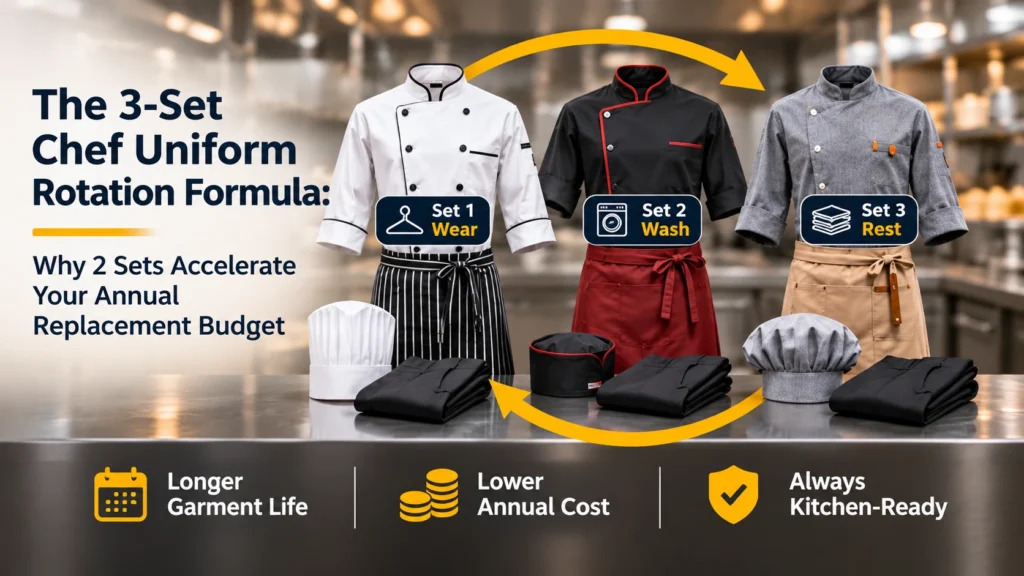
In a busy commercial kitchen, allocating only 2 uniform sets means each garment is washed, dried, and pressed every other day under high-temperature commercial cycles, leading to noticeable fabric fatigue and most likely forcing a full departmental replacement around Month 8. Moving to an institutional 3-set rotation (“One on Duty, One in Laundry, One in Locker”) for a 50-member culinary team reduces individual wash frequency by 33%, allowing Poly-Viscose fibers to rest between shifts. This extends the service life comfortably to 12–15 months and saves ₹80,000 across the operating cycle.
The Realities of Kitchen Shift Rotations
When planning annual budgets for a 50-member kitchen brigade, allocating 2 sets per staff member appears to offer an immediate 33% capital saving on day one. For an Executive Chef or Purchase Director, ordering 100 sets instead of 150 sets keeps the initial invoice lean.
However, kitchen teams work demanding 12-hour shifts around hot ranges, ovens, and prep stations. Because uniforms are exposed daily to food oils and high heat, they require frequent hot-water laundering and commercial steam pressing.
When a team operates on just 2 sets, each uniform is in constant transit: worn for 12 hours, laundered that night, and put back on the following day. Without time for the fabric to rest in an ambient locker environment, the continuous wash-and-wear loop accelerates wear and tear, making a replacement most likely necessary by Month 8.
The Science of Fiber Rest: Poly-Viscose in Daily Laundry
Poly-Viscose (PV) is the preferred fabric for institutional kitchen uniforms across India. It combines the clean drape and breathability of viscose with the tensile strength and color retention of polyester, all while remaining far more budget-friendly than heavy poly-cotton blends.
Even with durable 220–240 GSM Poly-Viscose drill, woven yarns undergo mechanical stretching and heat exposure during every commercial wash and calender press.
When garments receive 36 to 48 hours of resting time between shifts:
- Fiber Relaxation: The spun yarns release accumulated mechanical tension and settle back into their natural woven structure.
- Shape & Crease Retention: Chef jackets and trousers maintain crisp collar lines and comfortable drape without losing body.
- Seam Longevity: Stitches experience significantly less daily friction, keeping armholes, pockets, and stress points intact for over a year.
| Rotation Metric | 2-Set Allocation (Fast Wear) | 3-Set Allocation (Kapalie Standard) |
|---|---|---|
| Laundry Cycle per Set | Washed every 24 to 48 hours | Washed every 72 hours |
| Fiber Rest Window | Minimal (worn right out of laundry) | 36 to 48 hours (in staff locker) |
| Fabric Hand-Feel | Noticeable thinning by Month 6–7 | Crisp, structured body for 12+ months |
| Expected Lifespan | ~8 months (replacement most likely) | 12 to 15 months (full fiscal cycle) |
| Mid-Cycle Repurchase | Yes (likely full re-order at Month 8) | ₹0 (no repurchases required) |
The 15-Month Commercial Math: 50-Member Culinary Brigade
Consider an active culinary department of 50 staff members (Chef de Parties, Commi Chefs, Kitchen Stewards, and Bakers). A complete institutional 4-piece uniform set—including a tailored Poly-Viscose chef jacket, kitchen trousers, full bib apron, and chef cap—averages approximately ₹1,600 per complete set.
Option A: The 2-Set Model (Initial Budget Approach)
- Initial Allocation (Day 1): 50 staff × 2 sets = 100 sets @ ₹1,600 = ₹1,60,000
- Month 8 Replacement: Due to continuous daily laundering, uniforms are worn thin, prompting a planned mid-cycle replacement for the 50-member team: 100 sets @ ₹1,600 = ₹1,60,000
- Total Outlay Over 15 Months: ₹3,20,000
Option B: The 3-Set Rotation Protocol (The Institutional Standard)
- Initial Allocation (Day 1): 50 staff × 3 sets = 150 sets @ ₹1,600 = ₹2,40,000
- Month 8 Status: Zero replacement needed. Uniforms are rotating smoothly through laundry and personal lockers.
- Lifespan Achieved: 12 to 15 continuous months of daily kitchen service.
- Total Outlay Over 15 Months: ₹2,40,000
Net Operational Saving: ₹80,000 (25% Total Cost Reduction). Investing in the 3-set system on day one not only saves ₹80,000 over 15 months, but it also gives your Executive Chef complete peace of mind that every cook reports to duty in clean, fresh whites—even if a commercial laundry delivery is delayed by half a day.
The 5-Point Kitchen Uniform Specification Checklist
When preparing an RFQ or uniform renewal order, use these practical parameters to ensure your team receives high-performing kitchen attire:
- Rotational Allocation: Specify 3 full sets per staff member on roster to maintain a steady 3-day wash rotation cycle.
- Fabric Selection: 220–240 GSM Poly-Viscose drill for chef jackets and trousers, offering soft breathability and strong colorfastness at an institutional price point.
- Heavy-Duty Aprons: 240+ GSM dense-weave drill fabric with reinforced stitching at waist ties and neck straps for daily durability.
- Standard Institutional Fasteners: Quality heat-set chef buttons designed to withstand commercial laundry rollers and presses.
- Reinforced Seam Construction: Double-needle stitching on high-stress zones including trouser crotches, side pockets, and jacket armholes.
Consult the Factory Desk in Palace Guttahalli
For 56 years, Kapalie Uniforms has partnered with hotels, restaurants, and institutional caterers across Bangalore and South India. Visit our factory workshop at Vinayaka Circle to inspect our fabric rolls, touch our Poly-Viscose drill swatches, and review our finished chef jackets firsthand.